
 An interesting article has just been published in Contemporary Hypnosis and Integrative Therapy (disclaimer: I'm one of the authors). It tackles one of the logical inconsistencies in how we refer to the hypnotic ability of an individual. We often talk about the 'hypnotizability' of an individual after we have administered a test of hypnotic suggestibility. The problem with this is that when we administer the same test without a hypnotic induction, people often pass nearly as many items. Where does this leave hypnosis? What should we call this non-hypnotic ability? And how should we refer to the difference between these two scores?
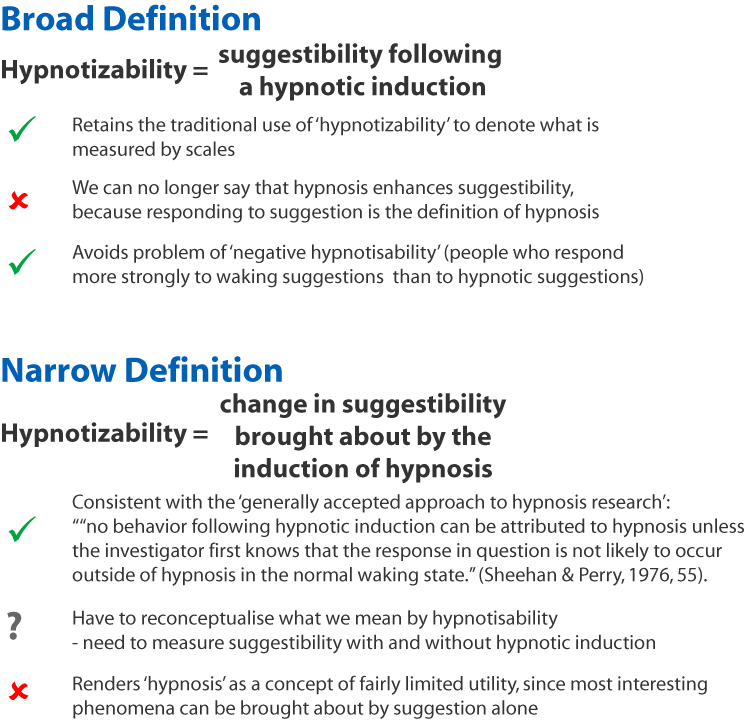
This consensus paper led by Irving Kirsch draws attention to the problems of defining hypnotizability and offers some solutions going forward. This is discussed in more detail on the defining hypnotizability page, but the image below outlines two good options.
Kirsch, I., Cardeña, E., Derbyshire, S., Dienes Z., Heap, M., Kallio S., Mazzoni, G., Naish, P., Oakley, D., Potter, C., Walters, V., Whalley, M. (2011). Definitions of hypnosis and hypnotizability and their relation to suggestion and suggestibility: A consensus statement. Contemporary Hypnosis and Integrative Therapy, 28(9), 107-115.
Read a pre-publication copy of this paper
What is hypnosis?
Definitions of hypnosis
Types of suggestion
FAQ
Scientific theories of hypnosis
History of hypnosis
Animal hypnosis
Key people in hypnosis
Demand characteristics
Scientific research
States of consciousness
Neuroscience
Modification of suggestibility
Attention and hypnosis
Pain research
Hypnosis as a research tool
Genes and hypnotizability
What is hypnotherapy?
Is it effective?
Finding a therapist
Depression
Irritable bowel syndrome
Pain
PTSD
Smoking
Surgery
Weight loss
Hypnosis research papers
Suggestibility scales
Scripts
Videos
Forum
Organisations
Journals
Book reviews
© 2007-2019 Dr Matthew Whalley